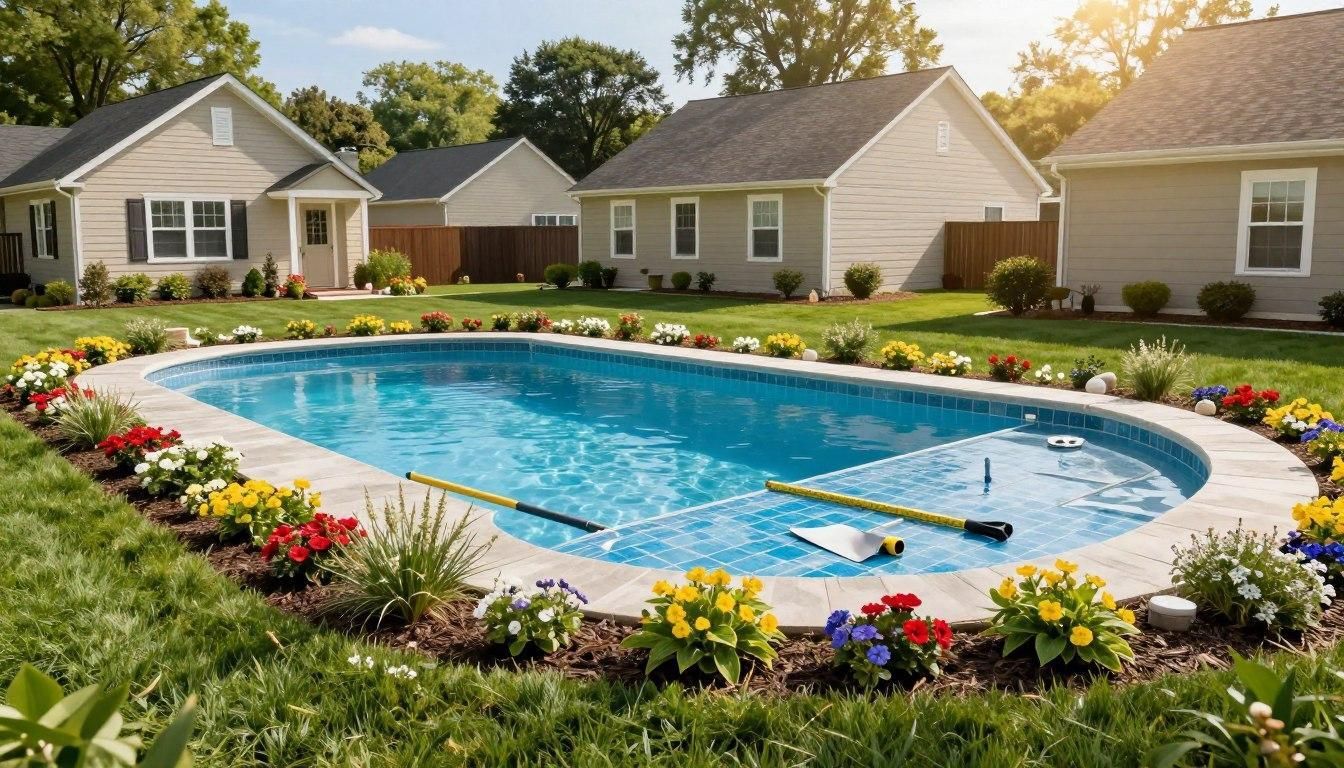
Pool Opening Checklist – Getting Your Pool Ready for Spring and Summer in Northern New Jersey
Key Takeaways
- Northern New Jersey pools are typically opened between late April and mid-May, ideally before Memorial Day weekend when daytime temperatures consistently reach 60°F or above.
- A proper pool opening service includes cover removal, deep cleaning, equipment startup, and full water balancing—simply pulling off the cover and adding shock treatment is not enough.
- Cold spring nights in North Jersey (often in the 40s°F through May) affect chemical reaction speeds, equipment run times, and overall timing for safe swimming.
- Serene Pools NJ offers professional pool opening services and can inspect for winter damage to concrete and gunite shells, tile, coping, and surrounding hardscapes.
- Request a quote from Serene Pools NJ for a worry-free, professionally opened luxury pool and outdoor living space ready for the season.
Introduction: Why a Proper Pool Opening Matters in Northern New Jersey
A correct spring opening sets the tone for a clean pool season from May through September. For pool owners in Northern New Jersey, the process involves far more than removing a pool cover and tossing in some pool chemicals. Your swimming pool has endured months of freeze-thaw cycles, accumulated other debris, and weathered conditions that can affect everything from the pool’s surfaces to your pump and filter system.
A comprehensive pool opening service includes cover removal, equipment inspection, plumbing check, and water chemistry balancing. Northern NJ spring conditions complicate DIY openings significantly. March brings lingering freeze-thaw cycles that can crack tile and shift coping. April delivers intense pollen bursts from oaks and maples that coat every surface. By early May, sudden warm spells exceeding 70°F create a breeding ground for algae growth under covers if you’ve delayed too long.
For concrete and gunite luxury pools, a sloppy opening can lead to staining, surface scaling, and premature wear on high-end finishes. Serene Pools NJ specializes in custom, luxury in ground pools and full outdoor living environments throughout Bergen, Morris, Essex, and Passaic counties. Proper pool care from day one protects your investment and keeps your pool safe all season.
When Should You Open Your Pool in Northern New Jersey?
Most North Jersey homeowners open pools from late April to mid-May, aiming to be ready by Memorial Day weekend. This timing aligns with when daytime highs consistently reach 60°F—a key threshold because pool water chemistry reactions slow dramatically in colder temperatures. Chlorine levels become less effective under 50°F, sometimes taking twice as long to sanitize properly.
Opening too early risks equipment damage from overnight lows still dipping into the 40s°F through mid-April. Opening too late invites green water and cloudy pool water problems as algae blooms flourish under covers during warm May days. Local pool service providers report significantly more algae incidents in May for homeowners who delay past early May.
Factors to consider when choosing your opening date include tree pollen spikes in your area, landscaper schedules for any pre-opening hardscape work, planned parties like June graduations, and whether you intend to use a heater for early-season swimming.
Serene Pools NJ can recommend an ideal opening window specific to towns like Ridgewood, Franklin Lakes, Livingston, and Montclair based on local conditions and your personal schedule.
Step 1: Pre-Opening Inspection Around the Pool and Hardscape
Before any pool opening service begins, luxury outdoor spaces need a thorough post-winter inspection. Your coping, patios, outdoor kitchens, and fire pits have all weathered Northern NJ’s harsh off season conditions and deserve attention.
A comprehensive pool opening service includes cover removal, equipment inspection, plumbing check, and water chemistry balancing. Start by checking concrete and gunite shells for visible hairline cracks wider than 1/16 inch, which may indicate potential spalling. Examine tile and coping for grout erosion or shifting caused by freeze-thaw cycles—North Jersey experiences 10-15 freeze cycles annually according to NOAA data. Inspect paver patios for winter heaving, which can cause settlement of 2-4 inches in sloped backyards.
Your safety checklist should include:
- Loose handrails requiring reinstallation with corrosion-resistant hardware
- Damaged or wobbly ladders
- Broken or missing drain covers (VGB compliance is absolutely essential)
- Loose stones on steps and around retaining walls
- GFCI breakers activated for all pool circuits
Serene Pools NJ identifies issues during professional openings that DIY inspections miss 80% of the time. The team can coordinate repairs to both pool structures and surrounding hardscapes before your summer entertaining begins.
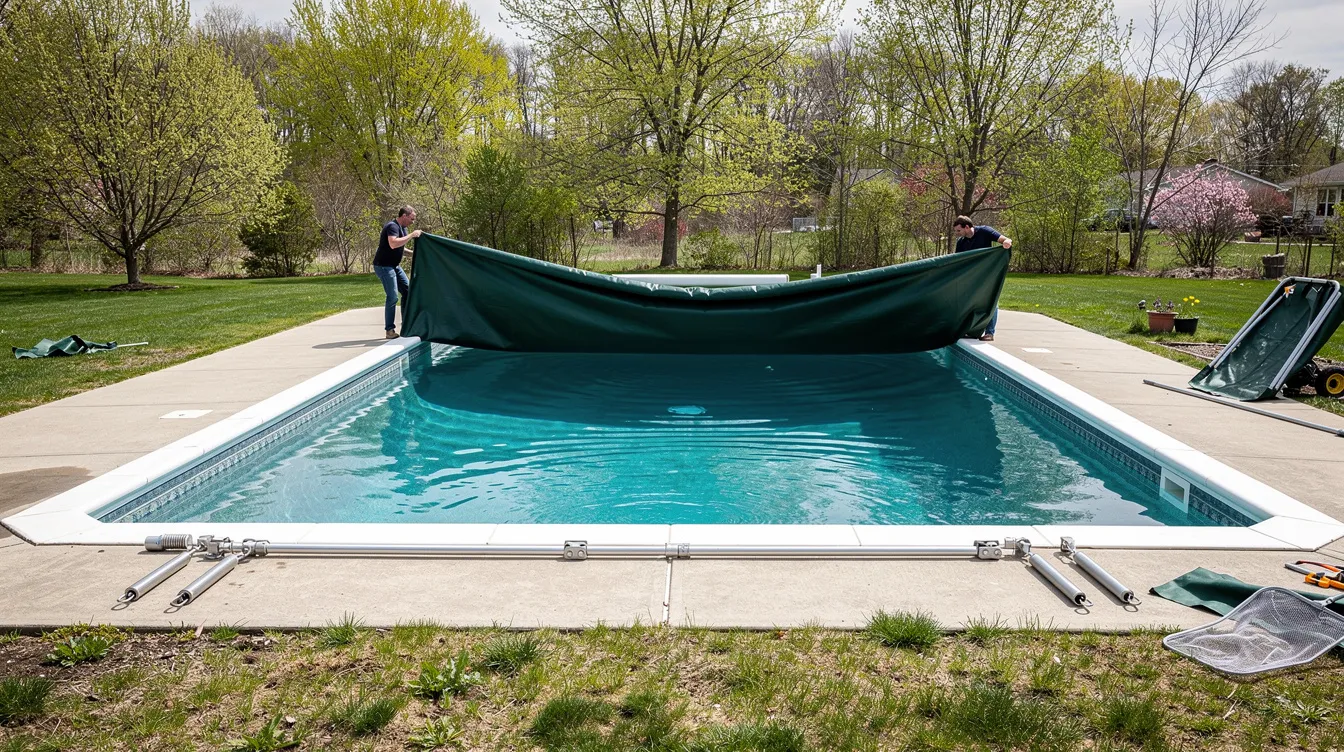
Step 2: Safely Removing and Cleaning the Pool Cover
Most Northern NJ luxury pools use solid safety covers or mesh safety covers rated to support 485 pounds per square foot under ASTM standards. Handling them correctly prevents dirty water and debris from contaminating your pool.
For solid covers, use a submersible pump (1/3 HP models handling 2,000 gallons per hour work well) to remove standing water before attempting removal. This step prevents dumping 20-50 gallons of debris-laden water directly into your clean pool. Brush and blow off leaves, twigs, and acorns—particularly common under the oaks and maples prevalent throughout Franklin Lakes and Livingston—before loosening springs.
Remove the pool cover panel by panel using proper spring tools to prevent tears. Lay the cover flat on a clean driveway or patio to scrub with pH-neutral detergent (avoid metal brushes that damage vinyl liner or mesh materials). Hose thoroughly and allow 24-48 hours of air-drying before folding and placing in a breathable storage bag.
Serene Pools NJ technicians inspect cover anchors, springs, and straps during service. If corrosion or wear exceeds 20% elongation, the team recommends replacement hardware to ensure your cover performs properly next winter.
Step 3: Reassembling and Inspecting Pool Equipment
After cover removal, all equipment winterized back in October or November must be carefully brought back online. This includes your pool pump, pool filter, heater, chlorinator, and any automation components.
Start by reinstalling drain plugs and pressure gauges on pumps, filters, heaters, and chlorinators that were removed to prevent freeze damage. Water expands approximately 9% when it freezes, which is why plugs are removed during winterization.
Key equipment steps include:
- Slowly fill the pump strainer basket with water to prime the system and expel air
- Check pump lids and O-rings for cracks or dry rot before starting
- Inspect your filter system type for damage: sand filters for channeling (voids deeper than 1 inch), cartridge filter elements for tears exceeding 10% surface area, or diatomaceous earth grids for pinholes
- Test pressurization by monitoring for leaks at unions and valves (target less than 5 PSI drop over 30 minutes)
Never dry-start your pump—doing so can overheat seals within minutes and reduce pump life by 50%. A Serene Pools NJ opening service includes visual inspection for leaks at unions, valves, and heater manifolds as the filtration system is first pressurized for the season.
Step 4: Starting Circulation and Cleaning the Pool
Early-season cleaning is typically more intensive due to winter debris accumulation, dormant algae spores, and heavy Northern NJ spring pollen that can reach 500-1,000 grains per cubic meter in April.
Begin by skimming large debris manually with a telescoping pole and net. Then brush walls, steps, tanning ledges, and benches thoroughly. For high-end plaster, pebble, or tile-finish pools, use nylon brushes to loosen dirt without etching surfaces. A baking soda paste works well for stubborn waterline marks on tile.
Once your pump achieves proper circulation with water circulating steadily at 20-30 PSI:
- Vacuum the pool to the waste port if the bottom is heavily soiled, bypassing the filter entirely
- This may dump 10-20% of your pool volume but prevents filter overload
- Use a manual vacuum with a vacuum plate for initial deep cleaning
- Robotic pool cleaners excel for ongoing maintenance but miss approximately 30% of benches and corners in custom shapes
Serene Pools NJ can also pressure-wash surrounding patios (1,500-3,000 PSI with low water volume to prevent runoff violations under NJ DEP stormwater rules) and clean waterline tile to restore a crystal clear, resort-like appearance.
Step 5: Testing and Balancing Your Pool Water for the Season
Water chemistry is the foundation of a trouble-free season. Properly balanced water protects concrete and gunite structures, preserves metal equipment, and keeps swimmers comfortable. Every new pool owner and veteran alike should understand these fundamentals.
Perform a full water test using a quality test kit or test strips from your local pool store. Check free and total chlorine, ph levels, total alkalinity, calcium hardness levels, cyanuric acid (stabilizer), and salt levels for salt water pools.
Target ranges for in ground pools:
| Parameter | Proper Range |
|---|---|
| pH | 7.4–7.6 |
| Total Alkalinity | 80–120 ppm |
| Calcium Hardness | 200–400 ppm |
| Cyanuric Acid | 30–50 ppm |
| Salt (SWCG systems) | 3,200–3,600 ppm |
| Adjust in sequence: alkalinity first (using sodium bicarbonate to raise 10 ppm per 1.5 lbs/10,000 gallons), then pH, then calcium, then stabilizer, and finally sanitizer levels. Cold 50°F water halves adjustment speeds, often requiring 2-3x dosing and 24-72 hour retests. | |
| Serene Pools NJ performs on-site water testing at opening and recommends chemicals tailored to your specific pool finish and equipment. |
Step 6: Shocking and Sanitizing After Winter
After Northern New Jersey’s long winter, pools typically need a strong initial shock treatment to oxidize organic buildup and eliminate algae spores that survived at 10,000-1,000,000 CFU/ml in dormant water.
Shocking should be done in the evening to minimize UV degradation—evening application retains approximately 90% of chlorine potency compared to daytime shocking. Run your pump continuously for at least eight hours afterward, extending to 12-24 hours if water temperatures remain below 60°F.
Shock options depend on your current pool water chemistry:
- Cal-hypo (68% available chlorine): Boosts calcium, good for low-calcium pools
- Dichlor (56% available chlorine): Adds stabilizer, useful when cyanuric acid is low
- Non-chlorine MPS oxidizer: Best for pools with already-high stabilizer levels
Keep swimmers out until chlorine returns to the safe range of 1-4 ppm. Test again the following day to confirm water balance has stabilized. Accurate volume calculation (length × width × average depth × 7.5 for rectangular pools) prevents under or overdosing by 20-30%.
Serene Pools NJ’s opening service includes calculating correct shock dosage based on actual pool volume—particularly important for large, custom-shaped luxury pools where estimates can be significantly off.
Step 7: Bringing Pool Automation, Lighting, and Features Back Online
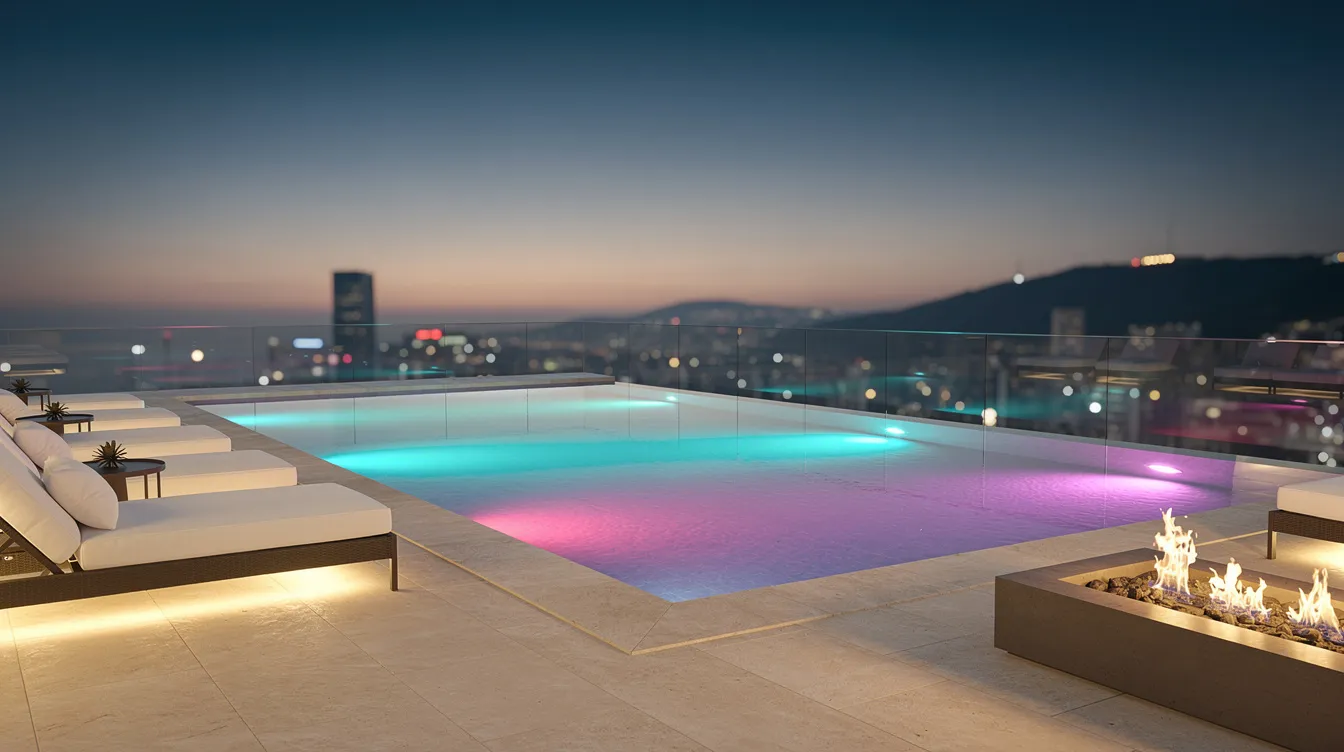
Many Northern New Jersey luxury pools feature automation systems, led lighting, waterfalls, deck jets, and spas that require spring startup. These luxury features enhance your personal retreat but need proper attention after months of dormancy.
Check pool automation panels and apps (Pentair, Jandy, Hayward systems) to confirm schedules, time settings, and WiFi connectivity after winter power outages. Reset clocks that may have lost time during extended outages.
Feature testing checklist:
- Color-changing LED lights (verify 24V transformers)
- Spa blowers and jets
- Laminar jets and sheer descent waterfalls (flush lines for clogs)
- Verify water circulating properly through all features
Gas heaters require special attention—check manifold pressure (4-8 inches water column) and consider a professional carbon monoxide safety inspection per NJ plumbing codes. Heat pumps need defrost cycle verification. Rushing heater startup in 40°F conditions can crack manifolds.
Serene Pools NJ specializes in integrating high-end automation and water features, ensuring these amenities function properly during every professional opening. Current trends show 70% of luxury pools now include automation systems.
Step 8: Early-Season Maintenance Schedule for North Jersey Pools
The first 4-6 weeks after opening (late April through early June) require extra attention as temperatures and bather loads increase. Establishing a pool cleaning schedule early prevents cloudy water and pool problems later.
Recommended early-season routine:
| Frequency | Task |
|---|---|
| Daily | Quick skim, visual check of skimmer basket and equipment |
| Weekly | Brush walls and vacuum, full water test, empty skimmer basket |
| Monthly | Backwash or clean filter (when pressure rises 15-25 PSI), inspect pump |
| Spring in Northern NJ brings heavy pollen and seed pods that overwhelm filters. Your skimmer basket may need emptying multiple times per week, and backwash frequency often doubles compared to summer. Keep your pool clear by staying ahead of debris before it sinks. | |
| Adjust pump run time from 8-10 hours in cool spring weather toward 10-12+ hours as water quality demands increase and temperatures exceed 78°F. This ensures proper pool maintenance and keeps water quality high. |
Serene Pools NJ offers recurring maintenance packages following opening—ideal for busy homeowners who want low maintenance, resort-level water clarity in their own backyard without weekly DIY work. Their blog on custom pool design, trends, and tips also helps homeowners plan upgrades and seasonal care.
How to Choose a Pool Opening Service in Northern New Jersey
Selecting the right pool opening service is essential for a safe, clean, and hassle-free start to your swimming season. Here are the key factors to consider when hiring a professional pool opening company:
- Comprehensive Service: Ensure the service includes cover removal, equipment inspection, plumbing check, and water chemistry balancing. A thorough pool opening should address all these areas, not just basic cover removal and chemical addition.
- Leak and Equipment Inspection: Confirm that the company checks for leaks and inspects the function of your pump and heater upon startup. Early detection of issues can prevent costly repairs and downtime.
- Certified Pool Operators (CPO) and Insurance: Only hire companies with Certified Pool Operators (CPO) on staff and valid liability insurance. This certification demonstrates professional knowledge and adherence to industry standards.
- Insurance Standards: Ask for proof of general liability insurance (at least $1 million per occurrence) and worker’s compensation coverage. These are standard protections for both homeowners and workers.
- Local Reviews and References: Check for recent local reviews and request references from the company. Reliable pool services will have a track record of satisfied customers in your area.
- Written Reports: Reputable pool companies provide written reports detailing chemical levels and all tasks performed during the visit. This transparency helps you track your pool’s condition and service quality.
- Additional Fees: Ask about extra charges for vacuuming, cleaning, folding, and storing the cover. Some companies charge $40 to $150 for these services, which may not be included in the base price.
- Book Early: Schedule your pool opening service early—ideally in March or April—to secure your preferred date and avoid the rush during peak season.
- Typical Cost Range: Expect to pay between $250 and $400 for a standard in-ground pool opening, with higher costs for concrete or gunite pools and additional services.
- Pre-Service Preparation: Before your appointment, fill the pool water level to the middle of the skimmer and remove debris from the cover to ensure a smooth and efficient opening.
By following these guidelines, you can confidently choose a pool opening service that will protect your investment and provide a safe, sparkling pool for the season.
Why Hire Serene Pools NJ for Your Professional Pool Opening?
Serene Pools NJ is a Northern New Jersey specialist in luxury, custom inground pool construction and outdoor living spaces—not a generic pool opening service company. The team brings a deeper understanding of high-end finishes, complex equipment, and the three c’s of proper pool care: chemistry, circulation, and cleaning.
Benefits of professional pool opening include:
- Expert handling of complex pump and filter system components
- Careful protection of high-end plaster, pebble, and tile finishes
- Early detection of winter damage that DIY inspections miss
- Time savings of 6-8 hours compared to homeowner attempts
- Knowledge of local water conditions and municipal codes
Serene Pools NJ bundles pool opening with inspections of outdoor kitchens, fire pits, hot tub installations, and hardscaping to prepare your entire backyard for spring entertaining, and their custom pool design services ensure these elements work together as one cohesive space. The team serves Bergen, Morris, Essex, and Passaic counties with expertise in the specific challenges each area presents and can transform your backyard with custom pools for every budget.
Ready to transform your own home into a personal retreat this season? Request a quote from Serene Pools NJ to schedule your professional pool opening and discuss any upgrades or repairs needed before summer arrives. Follow the manufacturer’s instructions and step by step instructions from the pros to keep your pool safe all season.
Frequently Asked Questions About Pool Opening in Northern New Jersey
How far in advance should I book a professional pool opening with Serene Pools NJ?
Peak demand runs from late March through early May, so homeowners should contact Serene Pools NJ 4-6 weeks before their target opening date. Early booking helps secure preferred dates before Memorial Day and allows time to coordinate any needed repairs discovered during pre-season inspection. Last-minute openings are sometimes possible, but schedule flexibility becomes limited in late April and May when most Northern NJ pools are opening simultaneously.
Can I open my pool myself and then hire Serene Pools NJ just for maintenance?
Many homeowners handle DIY openings, but Serene Pools NJ recommends at least a one-time professional opening for complex, high-value concrete or gunite pools. The company gladly provides ongoing weekly or bi-weekly maintenance even if you handled initial cover removal and startup yourself. Request a quote for a maintenance-only plan if you’re unsure about committing to a full professional opening—proper pool maintenance keeps your above ground pool or inground investment protected either way, and understanding the cost of a swimming pool in NJ can help you plan future upgrades or new construction.
Is it safe to open my pool if nighttime temperatures still drop into the 40s°F?
Generally yes, as long as hard freeze risk (below 32°F) has passed—typically by mid-April in Northern NJ. Cooler nights actually slow algae growth, though chemical reactions also take longer to achieve properly balanced water. You may need several extra days to fully clear and balance pool chemistry. Consider running the pump longer and using a heater or solar cover if you want to swim before late May.
How long does a full professional pool opening usually take?
A standard opening for an average-size inground pool typically takes 2-4 hours on site, depending on debris level and complexity of features. Additional time may be needed for extensive cleaning, troubleshooting equipment issues, or inspecting large hardscape and outdoor kitchen areas. Water clarity and full balancing may take 24-72 hours after opening as circulation and chemicals complete their work—remove debris daily during this period to help the process.
Can Serene Pools NJ also help upgrade my backyard when opening my pool?
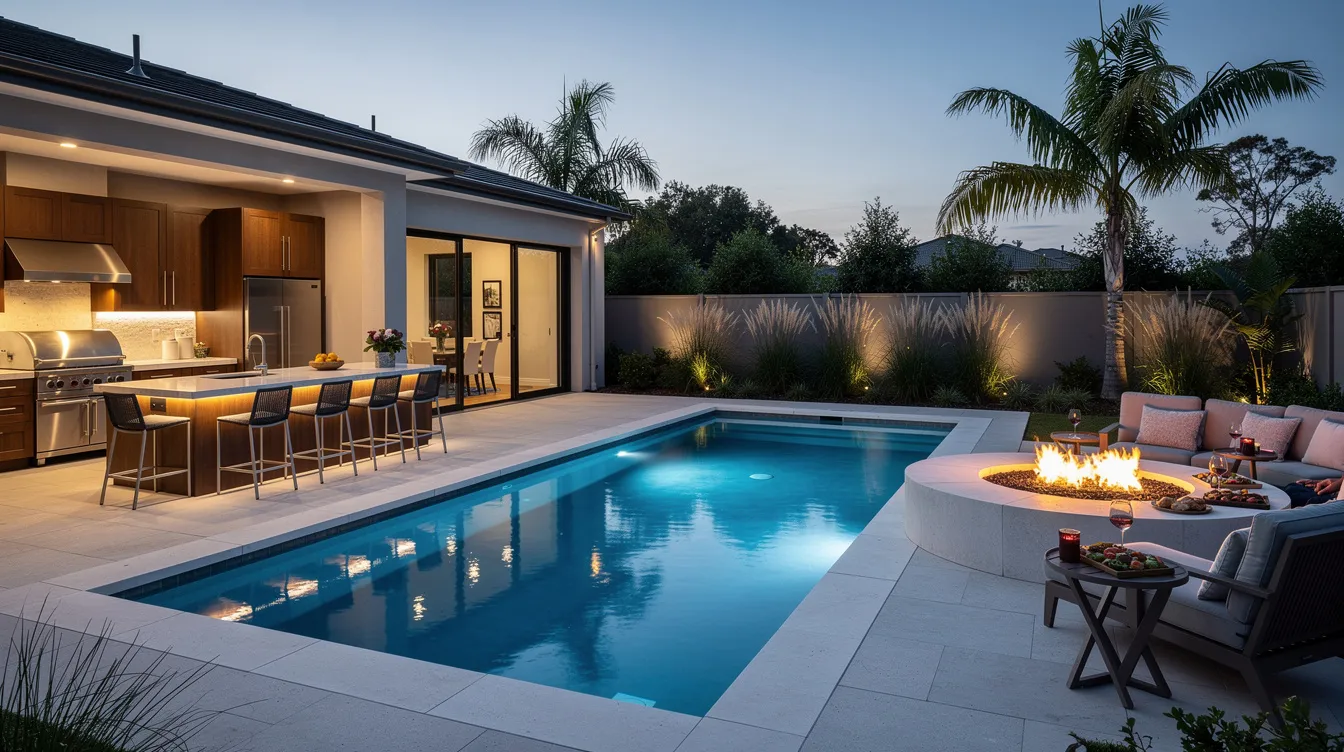
Absolutely. Serene Pools NJ specializes in designing and building complete outdoor living spaces, including patios, outdoor kitchens, fire features, and upgraded lighting that reflect the latest pool and hardscape trends. The opening appointment is an ideal time to discuss renovation ideas like new water features, resurfacing a gunite pool, or expanding hardscape areas with custom swimming pool design tailored to your property. Mention your interest in upgrades when you request a quote, and the team will prepare design options from Serene Pools’ expert craftsmen and timelines tailored to the upcoming season.
What should I look for when choosing a pool opening service?
When selecting a pool opening service, make sure the company provides a comprehensive service that includes cover removal, equipment inspection, plumbing check, and water chemistry balancing. Confirm that they check for leaks and inspect the pump and heater function. Only hire companies with Certified Pool Operators (CPO) and valid liability insurance—ask for proof of at least $1 million in general liability coverage and worker’s compensation. Check for recent local reviews and references to assess reliability. Reputable services provide written reports of chemical levels and tasks performed. Ask about additional fees for vacuuming and cover cleaning, as these may not be included in the base price. Book early to secure your preferred date, and expect to pay $250–$400 for a standard in-ground pool opening, with extra costs for concrete or gunite pools and additional services. Before the service, fill the pool water to the middle of the skimmer and remove debris from the cover for a smooth process.